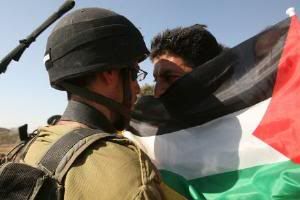
Bassem Tamimi at his court hearing in Ofer prison, 12 April 2011. (Oren Ziv/
ActiveStills)
When I met Bassem Tamimi at his home in the occupied West Bank village of Nabi Saleh this January, his eyes were bloodshot and sunken, signs of the innumerable sleepless nights he had spent waiting for Israeli soldiers to take him to prison. As soon as two children were seized from the village in the middle of the night and subjected to harsh interrogations that yielded an unbelievable array of “confessions,” the 44-year-old Tamimi’s arrest became inevitable. On 25 March, the army finally came, dragging him away to Ofer military prison, a Guantanamo-like West Bank facility where he had previously been held for a 12-month term for the vaguely defined crime of “incitement.” His trial before a military court that convicts more than 99 percent of Palestinians brought before it is scheduled to begin on 8 May.
Like nearly all of his neighbors, Tamimi has spent extended time in Israeli detention facilities and endured brutal treatment there. In 1993, he was arrested on suspicion of having murdered an Israeli settler in Beit El. Tamimi was severely tortured for weeks by the Israeli Shin Bet in order to extract a confession from him. Tamimi said that during the torture he was dropped from a high ceiling onto a concrete floor and woke up a week later in an Israeli hospital. In the end, he was cleared of all charges.
With his wife, Nariman, and his brother, Naji, Tamimi has been at the center of Nabi Saleh’s popular resistance against the occupation since its inception in 2009. The village’s unarmed struggle has brought hundreds of Israelis and international activists to participate each Friday in boisterous and theatrical demonstrations that invariably encounter harsh Israeli violence, including the use of live ammunition against children. While other villages involved in the popular struggle have seen their ranks winnowed out by a harsh regime of repression and imprisonment, Nabi Saleh’s protests continue unabated, irking the army and frustrating the settlers of Halamish, who intend to expand their illegal colony further onto Nabi Saleh’s land.
Tamimi and I spoke amid the din of a stream of visitors parading in and out of his living room, from international activists living in the village to local children to a group of adolescent boys from the nearby town of Qurawa, who told me they came to spend time with Tamimi and his family “because this is what the Palestinian struggle is about.” Tamimi is a high school teacher in Ramallah and his professorial nature is immediately apparent. As soon as I arrived at his front door for what I thought would be a casual visit, he sat me down for an hour-long lesson on the history, attitudes and strategy that inform the brand of popular struggle he and his neighbors had devised during weekly meetings at the village cultural center.
Our discussion stretched from the origins of Nabi Saleh’s resistance in 1967 to the Oslo Accords, when the village was sectioned into two administrative areas (Areas B and C), leaving all residents of the Israeli-controlled portion (Area C) vulnerable to home demolition and arbitrary arrests. Tamimi insisted to me that Nabi Saleh’s residents are not only campaigning to halt the expropriation of their land, they seek to spread the unarmed revolt across all of occupied Palestine. “The reason the army wants to break our model [of resistance] is because we are offering the basis for the third intifada,” Tamimi said.
Max Blumenthal: There are rumors that the Israeli civilian administration will demolish your home if you continue the popular resistance. Is there any truth to that and on what grounds can they carry out the demolition?
Bassem Tamimi: My house was built in 1964 when this area was controlled by Jordan. Back then it was easy for me to get a permit to renovate. Now when I want to add a second level to the house for my family of course I can’t get a permit from the Israelis so I am forbidden to build. In this way they are forcing the next generation of our village to move to Area B in the center of the village. Their goal is to carry out a form of indirect transfer that will make Nabi Saleh into a refugee camp in the near future. The village will then be nothing more than a hotel that provides workers for the Palestinian Authority, maybe with no school and definitely with no relation to our land, since we will be forced off of all the parts we can farm. In the future, Area C will be empty and all of us who live there will have to move to places like Birzeit which are located in Area A.
I wanted to build a wall around my garden and I didn’t do it. The reason I didn’t was that it would have only been demolished since I am not able to get a permit. I didn’t want to risk them demolishing my house. All the new houses built after Oslo were in Area B but we have not been able to build a single new house in Area C.
MB: How has the expansion of the nearby illegal Jewish settlement Halamish influenced the popular resistance in Nabi Saleh?
BT: In 1976, the settlers came to an old British military camp on our land. The next year they built a settlement called Halamish. I asked one of them what right he had to the land. He told me his right was in the Bible. The Labor government blocked construction of the settlement, but a year later when Menachem Begin and Likud were elected, they allowed it to go ahead. During the second intifada, the army made the whole area around our village a closed military zone. This allowed Halamish to expand even more onto our land. Then in 2008 the army demolished the second fence around our village, another step for more expansion. So we see the steps they are taking to push us out of Area C and off our land.
Our problem is not just with the settlement of Halamish. Our problem is the whole occupation. The settlement is merely a face of the occupation. In Bilin and Nilin they set specific goals like moving the separation fence to the green line [Israel’s internationally-recognized armistice line with the occupied West Bank]. That is a problem. Our only goal is to end the occupation. So if the American consul came to us and said, “I am Superwoman; I can immediately remove Halamish,” I would say, “Fine, but we want to end the whole occupation.”
MB: When did Nabi Saleh choose to wage an unarmed popular struggle and why?
BT: This village has a long history of resistance. It is part our culture. We have had 18 martyrs since 1967. Most of our youth are taken away to prison. I have been arrested ten times and placed under administrative detention.
We have experience in military resistance but we decided the best way to resist was nonviolent. We want to build a model that looks like the first intifada, an alternative to military resistance. Our village knows exactly what to do because we were involved in the intifada. And the reason the army wants to break our model is because we are offering the basis for the third intifada.
For my whole life most of the Israelis I met were soldiers and interrogators. But when we started the popular resistance in 2009 I began to see that there were some Israelis who had removed the occupation from their minds. Like Jonathan [Pollack], who was the main person to bring Israelis and internationals here in the beginning. So we became friends.
The occupation is continuous in Israeli society and this is why they lose — because they try to force us to accept them as an occupier, and that will never happen. We don’t have any problem with Jewish people. Our problem is with Zionism. We don’t hate them on the other side; we simply demand that they end the occupation of their minds. The separation between us is between different ways of thinking, not between land. If we change our ways of thought and remove the mentality of occupation from our minds — not just from the land — we can live together and build a paradise.
MB: Your demonstrations have been criticized by outsiders because the throw stones at the soldiers. Meanwhile, the Israeli army claims stone-throwing is an armed attack or a form of violence so the popular resistance is not really nonviolent. What do you make of these claims?
BT: We are building the popular struggle from our culture and our history. Only after we build an authentic struggle do we begin to debate our tactics. And throwing stones is a part of our culture. Historically we threw stones when something frightened us like a snake or a bear. Now, when a soldier comes into our village and shoots tear gas we won’t just sit there like a victim. They are protected from live bullets so we’re clearly not trying to take a life. With stones we are simply saying, “We don’t accept you here as an occupier. We don’t welcome you as a conqueror.”
MB: What is your relationship with Fatah and the Palestinian Authority like?
BT: We had an intifada based on popular struggle but the Oslo accords crushed it. Now the people are tired after the second intifada was crushed. So Fatah talks and talks but they can’t manage to bring [the popular struggle] across the West Bank. Fayyad wants to come here and be seen and use our struggle as a theater to have his picture taken. We know that Fatah could bring thousands of people here but they don’t want to. They don’t order their members to join the struggle. We want to ask them to make popular struggle everywhere. We do all that we can but without them, we can only do so much.
MB: Do you see any role for the peace process in ending the occupation?
BT: In thirty years the Europeans and the United States paid 5 billion dollars for normalization projects but they give us no steps towards a solution. If they want to do something to stop the occupation they should stop these initiatives that put people up in five star hotels to do dialogue. It’s not common sense! And all these academics who come here to study us and then go and write about how throwing stones is violent — that means nothing to us! Popular resistance is a way of life that means being close to the ground. I’ve been in the dialogue workshops and they are a complete waste of money. Both sides are suffering under the occupation but in a different way. [Israeli soldier] Gilad Shalit was captured but who sent him to occupy and kill? The normalization initiatives never address questions like this.
MB: One of the key differences between the demonstrations in Nabi Saleh and in a place like Nilin is the role of women. Every time I come here on a Friday the women are at the front of the protest while in Nilin they are not always that visible. Is this deliberate?
BT: From the beginning of our struggle the Israelis targeted the women of our village. For example, my wife, Nariman, was arrested and jailed for ten days. The army targets the women here because they know our culture; they know that we see women as 50 percent of our struggle and no less. Women [raise] our children. Women can convince people more easily than men. When our men see the women being brave, they want to be more brave. Women are in the center of our struggle because we believe women are more important than men. It’s that simple.
MB: What do you think army’s long-term objective is?
BT: The army is determined to push us toward violent resistance. They realize that the popular resistance we are waging with Israelis and internationals from the outside, they can’t use their tanks and bombs. And this way of struggling gives us a good reputation. Suicide bombing was a big mistake because it allowed Israel to say we are terrorists and then to use that label to force us from our land. We know they want a land without people — they only want the land and the water — so our destiny is to resist. They give us no other choice.
Max Blumenthal is an award-winning journalist and bestselling author working in Israel-Palestine. His articles and video documentaries have appeared in The New York Times, The Los Angeles Times, The Daily Beast, The Nation, The Huffington Post
, Salon.com, Al-Jazeera English and many other publications. He is a writing fellow for the Nation Institute. His book, Republican Gomorrah: Inside The Movement That Shattered The Party
, is a New York Times
and Los Angeles Times
bestseller. Uprooted Palestinian