Thursday, March 11, 2010

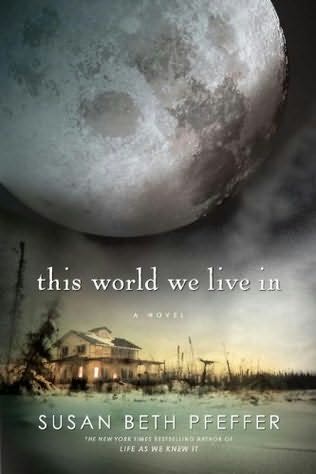
Book Review: This World We Live In by Susan Beth Pfeffer

The third book in Susan Beth Pfeffer's series of young adult post-disaster novels, This World We Live In attempts the daunting task of bringing together characters from the previous books (Life As We Knew It and The Dead and the Gone). At that task, it succeeds with flying colors and provides another character-driven novel in world gone horribly wrong.

Miranda and her family have survived the worst after the moon was knocked into a closer orbit around the Earth by a meteor, but they're not out of the woods yet. Food is scarce, electricity is on-again-off-again at random, and the sudden arrival of Miranda's father and stepmother, and a few unexpected guests, is making things more difficult. But with these new guests is Alex Morales (The Dead and the Gone), and soon Miranda and Alex find themselves in conflict with their growing feelings for one another and the harsh reality that is their future in a world brought to its knees by nature.

Much like Life As We Knew It and The Dead and the Gone, This World We Live In captures the essence of family in all the right ways. Miranda's family is an amalgam of the kinds of families we see in the world today (here in the West, anyway): we have the divorced parents, the stepmother, the turmoil between brothers and a daughter in a world no longer founded upon the same equal opportunity we take for granted today, the injection of other people into the social stratum of the family unit (much as friends become members of the family, even though they aren't). Pfeffer continues to make family, social structures, and character the central focus of her novel, despite being set in an future where one could have a heyday with action and violence. Her characters are (still) flawed, and yet lovable regardless. We might not like the way they all act from time to time, but throughout the narrative (and the series as a whole) we come to understand how humanity often needs copious amounts of time to properly adjust to a catastrophic event.

In a way, I can't help seeing the analogy between the Great Depression and Pfeffer's out-of-place-moon future, where mankind is thrust into awful situations where even those who were moderately fortunate before are forced to change against strict, horrible social/cultural/physical pressures. Perhaps that is what makes This World We Live In, and the previous two novels, engaging and real. It's not Doomsday or I Am Legend, but an unintentional response to that kind of action-focused post-disaster genre--a response that seems to work without becoming preachy or too geared towards a particular gender or age group (even though it is a young adult novel).

It would be pointless to sit here repeating what I have already said about this series. This World We Live In is as much a thrill to read as the previous two novels, and much of the praise I have for this latest edition can be found in those previous reviews (here and here). The epistolary format continues to work surprisingly well, the characters are surprisingly human (they irritate, they amuse, and they make good and bad decisions), and the ambiguity of the ending is both a warm, if not morbid, moment, and a reminder of our fragility as a species. Hopefully Pfeffer will show us more of this world, either through the eyes of her previously established characters, or via the introduction of new characters from entirely different situations (it would be interesting, for example, to see how the richest people of the world are coping with the "end of the world"). We'll see.

The only recommendation I have for anyone interested in this novel (besides the obvious suggestion of picking it up and reading it) is not to read the back cover. This may be isolated to the uncorrected proof I received for review, but the synopsis on the back cover of my edition essentially gives away the ending. Don't read it.

If you want to learn more about This World We Live In, head on over to Harcourt. The novel is due for release in April on Amazon or anywhere you buy books. Susan Beth Pfeffer can be found on her blog.

Academy Award Winning Movie Trailer

219th


this is a prelim ilustration i drew & colored in prep for the story "curt connor's in shed; prologue" writen by zeb wells and colored on the book by mat hollingsworth published in web of sipider-man #6

Wednesday, March 10, 2010

Giveaway! "Shadow Prowler" by Alexey Pehov

I have a copy of "Shadow Prowler" by Alexey Pehov up for grabs on my giveaway page. This one looks good, so be sure to CHECK IT OUT.

"A360" Concept car from UFO

UFO, the vehicle is mysterious extraterrestrial be can't float especial in the sky. Because, now it can run on the road is like general car. but, it doubtful that if come true as though, how is it will can run?

The designing
vehicle idea that the figure is like UFO this call that "A360". It was designed looks like a crossbreed between a UFO and some stealth fighter jet. The triangular body has a panoramic glass roof, and then there is the camera system on the exteriors that works to provide the driver with additional feedback. The car moves on three spheres, not wheels, which actually make some sense considering that it is capable of moving in any direction on the ground.

"A360" design the wheels are spherical, resembles a ball. If need not move as the car makes a radical change in angle. To settle well with the new direction, the cabin is capable of a full rotation. To accommodate these functions, the steering wheel has undergone a bit of a change. A control ball takes the role of a steering wheel, with integrated functions for right, left and rotation.

Designer: Huynh Ngoc Lan


If you liked this vehicle, you would also be interested in:
www.local-motors.com

Tuesday, March 9, 2010

Book Review: Ray In Reverse by Daniel Wallace

Most of you probably remember Daniel Wallace as the author of Big Fish, which was eventually turned into a fantastic movie staring Ewan McGregor. Fans of Big Fish will likely get the same sense of enjoyment from Ray in Reverse. I found this book on a bargain shelf at Books-a-Million and decided to read it. You'll see why I'm glad I did.

Ray in Reverse is a downright strange narrative with a unique and stunning conclusion. Ray Williams is dead and in heaven, where support groups collect people together to discuss various aspects of their lives. But Ray is in the Last Words group, where everyone is discussing the last things they said before death, and embarrassment is setting in: Ray's last words weren't all that interesting, let alone complete. What follows is a chronologically reversed narrative about Ray's life, starting from old age and taking leaps further and further back in time to his childhood, before finally returning back to Heaven. We learn about his triumphs and failures, his wants and desires, and, most of all, the kind of man he came to be through all the trials and tribulations of life.

Daniel Wallace has a pension for telling strange and engaging stories. I only saw the movie for Big Fish, but much of the magic and wonder that made that movie shine is also at work in Ray in Reverse. While the narrative does leave many questions open to speculation, the way Wallace has tried to capture the essence of a man, rather than the brilliance of a plot, is something worth noting. The narrative cannot possibly capture every moment in Ray's life to put together some sort of cohesive plot, but it can look into what makes Ray tick, and does so to great effect. We see Ray's life in glimpses in much the same way that we remember the most vivid moments of our pasts in glimpses. Certain memories stick out for us--just as they do for Ray--and when you put them all together they paint a unique picture of you. Ray's backwards motion glimpses do just that, and, by the end, we start to understand who he is, especially in terms of his faults. We also come to understand why the beginning of the novel is so prescient: Ray is the everyman looking back upon himself and wondering, "Who am I?"

Ray as everyman is a key thing to note about the novel. He's not perfect--not by a long shot. Ray cheats, thinks ill of other people, and succeeds and fails in much the same way that all of us do. Wallace doesn't pull punches for Ray, because to do so would take away from Ray's tragic, yet painfully average life. Flawed characters are strong characters. I think this is part of what makes the novel so enjoyable to read, because it takes what is so normal and everyday and makes it glamorous in its normality and flaws, for good or for bad. Wallace has a knack for doing just that, because even Big Fish has that kind of normality-turned-to-glamorous feel.

Wallace's adept storytelling, however, makes difficult for me to find fault with this novel. On the one hand, I loved the way the narrative was pieced together with glimpses; on the other hand, the glimpses also left a few too many holes for my liking, leaving me with a lot of questions at the end. But, at the same time, those questions are part of how the ending comes together, because even Ray is questioning his life. It's a Catch 22 for a reader, I suppose. Regardless, perhaps a few more glimpses could have made for a more rounded picture, but only if doing so wouldn't detract from the ending.

Needless to say, I loved Ray in Reverse. Ray is memorable, the structure of the narrative and the two Heaven scenes framing it make for a fascinating and engaging read, and the everyman has, finally, a little magic attached to the title. Hopefully we'll see more of Wallace in the future. For now, we have Big Fish and Ray in Reverse (and, apparently, a couple other novels I've never heard of before).

Ray in Reverse can be found on Amazon or your local bookseller. If you'd like to learn more about Daniel Wallace, visit his website.

"Tron Legacy" Trailer